Injectable PrEP in Australia: The 2-Monthly Shot and the Twice-a-Year Shot
Daily PrEP works. But taking a pill every day isn’t for everyone, and for years I’ve had people ask me the same question: “When are the PrEP injections coming?”
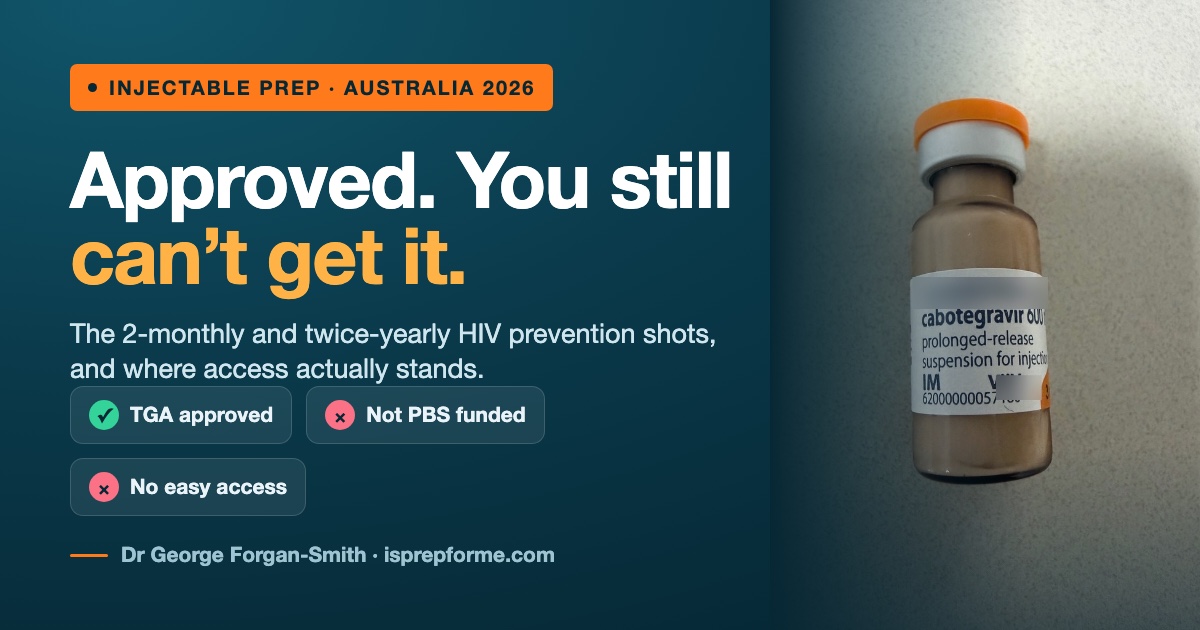
Good news, team. Injectable PrEP is real, it’s been through the big trials, and the results are some of the strongest we’ve ever seen in HIV prevention. The catch, if you’re in Australia, is that it isn’t available yet outside of some very rare circumstances.
Here’s where the two injectable options stand, and what that means depending on where you live.
TL;DR: the 60-second version
- Two injectable PrEP options exist: cabotegravir, given into the muscle every 2 months, and lenacapavir, given under the skin twice a year.
- The trial results are excellent. Lenacapavir had zero infections in one study and was about 89% better than the daily pill in another.
- Both are TGA-approved in Australia but neither is funded on the PBS, so there's no routine way to get them here yet.
- Without a subsidy there's no reliable Australian price. Overseas sticker prices land near A$38,000 a year (2-monthly) and A$42,000 a year (twice-yearly) as a rough guide.
- Daily PrEP is still here, still works, still PBS-subsidised at around $25 a month. If daily is hard, ask about on-demand 2-1-1 dosing.
Why an injection instead of a pill?
A daily tablet only protects you if you actually take it. Life gets in the way: travel, a rough week, wanting privacy at home, side effects you’d rather not think about every day.
An injection moves protection from “remember every single day” to “turn up to an appointment a few times a year.” For anyone who finds daily dosing hard, stigmatising, or just impractical (and for people in rural and remote areas), that’s a real shift.
Two products have made it through the major trials. They work differently and on different schedules.
Option 1: Cabotegravir, every 2 months
Cabotegravir is a long-acting injection into the muscle, given once every 2 months. It works in a completely different way to the daily pills. To take hold in your body, HIV has to splice its own genetic code into your cells’ DNA. Cabotegravir blocks the exact tool the virus uses to do that (the technical name is an integrase inhibitor), so HIV can’t get established in the first place.
The evidence is solid. In the HPTN 083 trial (gay and bi men and trans women), there were 13 HIV infections on the injection versus 39 on the daily pill. In HPTN 084 (cisgender women), it was 4 versus 36. Both trials were stopped early because the injection was clearly doing better. 1
One honest point: a lot of that “better than the pill” result comes down to adherence. The pill is excellent when it’s actually taken. The injection just takes daily-remembering out of the equation. So if your daily routine is rock solid, the injection is a convenience upgrade rather than an efficacy one. If daily dosing is a battle, you get both.
Option 2: Lenacapavir, twice a year
This is the one that’s been making headlines. Lenacapavir is an injection given just under the skin, twice a year, with a short run of tablets to get you started. HIV carries its genetic material inside a tough protein shell, called a capsid, that it needs both to break into your cells and to build new copies of itself. Lenacapavir jams that shell (the technical name is a capsid inhibitor), so the virus can’t do either job.
The results are remarkable. In the PURPOSE 1 trial in cisgender women, nobody in the lenacapavir group caught HIV during the study. Zero infections. In PURPOSE 2 (gay and bi men, trans men, trans women and gender-diverse people), there were 2 infections on lenacapavir versus 9 on the daily pill, roughly 89% better than the daily tablet. 2
A fair word on that “100%”: it means no infections happened during a well-run trial, not that the drug makes you bulletproof. No medicine is a forcefield. But twice-yearly dosing with protection this strong is a genuine leap forward.
The Australian reality: approved, but you can’t get it
Here’s the part that frustrates me. Both injectables are TGA-approved in Australia. Cabotegravir got the tick in 2022, lenacapavir in December 2025. And neither one is actually available to prescribe. 3
TGA approval and PBS funding are two separate steps. A medicine can be legally registered and still not subsidised, and without that subsidy these injections are out of reach for almost everyone.
- Cabotegravir: the manufacturer and the PBS pricing committee couldn’t land on a price, so it’s been stuck since 2023. For cabotegravir there is one narrow exception: a compassionate access program with very limited places. If taking PrEP tablets is a real problem for you (gut issues, severe side effects, or other medical or social reasons that make daily PrEP unsafe or hard to keep up), talk with your doctor. They may be able to put in an application for compassionate access on your behalf.
- Lenacapavir: as of June 2026 there isn’t even a PBS submission lodged for the PrEP version, and there’s no compassionate access scheme for it at the time of writing.
So if you’re in Australia and you’ve been holding out for the PrEP jab, the straight answer is “not yet.” Health groups here are pushing hard for both to be funded, because right now the access gap is the only thing between Australians and a tool the trials say is excellent.
So what would it actually cost?
It’s the first question people ask once they hear “not subsidised,” and it’s a fair one. The honest answer: there’s no reliable Australian price for either injection yet. Neither is on the PBS as PrEP, and neither is sold here through normal channels, so any local dollar figure you see is guesswork.
There is one real Australian clue, though. We’ve already got a long-acting injectable HIV treatment in use here, given as two injections at each visit. One of those two is the exact same drug as the 2-monthly PrEP shot (cabotegravir); the other is a partner drug used only in people who already have HIV. That treatment is on the PBS, so we actually know what it costs: before the subsidy, the government put the price at more than $17,000 a year. The PBS then knocks that down to a standard co-pay for the patient (about $25 a script, less with a concession card). 4
That’s the closest thing we’ve got to an Australian price tag for long-acting cabotegravir, and it sits a bit below the US figures further down (which is what usually happens once the PBS negotiates). It also makes the point cleanly: the drug can be made and funded in Australia, so what’s holding up the PrEP version is the funding deal, not the science.
To round out the picture, look overseas, where both are already on sale. The United States publishes its list prices:
- Cabotegravir, the 2-monthly shot: around US$4,200 a dose, six doses a year. Call it US$25,000 a year, which converts to somewhere near A$38,000.
- Lenacapavir, the twice-yearly shot: around US$14,000 a dose, two doses a year. About US$28,000 a year, or close to A$42,000 converted. 5
A few honest caveats. Those are list prices, not necessarily what a patient pays overseas, where insurance and assistance schemes soften the hit. The exchange rate moves, so read the Australian figures as ballpark, not a quote. Independent Australian estimates for the twice-yearly option have landed in a similar range.
For contrast, daily PrEP costs about $25 a month on the PBS, less with a concession card. That gap is the whole story. The trials are done and the drugs work, but until a PBS deal lands, the price tag keeps “approved” and “available” worlds apart.
If you’re reading from overseas
Access depends entirely on where you are. The World Health Organization now recommends lenacapavir for PrEP, the US approved it in 2025, and by early 2026 a number of countries (including several across Africa) had already started rolling it out. Cabotegravir is available through various funding routes in the UK, US and parts of Europe. 6
So depending on your country, one or both of these may already be on the table. Ask a local sexual health clinician what’s funded where you live.
What to do right now
If you’re in Australia: daily PrEP is still here, still works, and is still PBS-subsidised at around $25 a month (less with a concession card). If daily is hard for you, on-demand 2-1-1 dosing is worth asking about if you’re eligible. The injectables aren’t a reason to skip the protection you can actually get today.
Wherever you are, the move is the same. Talk to a sexual health doctor or a PrEP-friendly GP about what’s available to you, and keep your testing up.
I’ll update this page the moment the access picture in Australia shifts. The science is ready. We’re waiting on the paperwork.
Common questions
Is injectable PrEP available in Australia?
Not in the usual way yet. Both options are TGA-approved (cabotegravir in 2022, lenacapavir in December 2025), but neither is funded on the PBS, so there’s no routine way to access them. The one narrow exception is a limited compassionate access program for the 2-monthly cabotegravir injection, which a doctor can apply to for people who genuinely can’t use oral PrEP. For almost everyone, daily or on-demand tablets remain the available options.
How often do you need the PrEP injection?
It depends which one. Cabotegravir goes into the muscle once every 2 months (six times a year). Lenacapavir goes just under the skin twice a year, with a short course of tablets to start.
How much does injectable PrEP cost without the PBS?
There’s no reliable Australian price, because neither is funded. The closest real anchor is the long-acting injectable HIV treatment that uses the same cabotegravir, which is on the PBS and costs more than A$17,000 a year before the subsidy. As a guide to the scale overseas, list prices work out to roughly A$38,000 a year for the 2-monthly injection and around A$42,000 a year for the twice-yearly injection. Those are overseas sticker prices, not a quote. Daily tablets, by contrast, are about $25 a month on the PBS.
How well does injectable PrEP work?
The trial results are among the strongest in HIV prevention. The 2-monthly injection had fewer infections than the daily pill in its trials, largely by removing the need to remember a tablet. The twice-yearly injection had zero infections in one study and was about 89% better than the daily pill in another. No medicine is a guarantee, and these are trial results rather than a promise of total protection.
What’s the difference between the two injections?
They block HIV differently and on different schedules. Cabotegravir (every 2 months, into the muscle) stops HIV splicing its code into your cells. Lenacapavir (twice a year, under the skin) jams the protein shell HIV uses to break in and copy itself.
Can I get the twice-yearly injection now?
Not in Australia yet. But the World Health Organization recommends it, the US approved it in 2025, and several countries (including a number across Africa) had begun rolling it out by early 2026. Access depends on where you are, so ask a local clinician what’s funded.
Stay safe, team.
Dr George
This information is general in nature and not a substitute for personalised medical advice. Speak to your doctor about your specific situation. The injectable options described are not currently available in Australia, and your doctor decides what’s suitable for you and what can be prescribed where you live. Current as of June 2026.
Dr George Forgan-Smith, GP, practising in Melbourne. AHPRA MED0001197864.
-
HPTN 083 and HPTN 084 trials of long-acting cabotegravir for HIV pre-exposure prophylaxis. New England Journal of Medicine. https://www.nejm.org/doi/full/10.1056/NEJMoa2101016 ↩︎
-
PURPOSE 1 and PURPOSE 2 trials of twice-yearly lenacapavir for HIV pre-exposure prophylaxis. New England Journal of Medicine. https://www.nejm.org/doi/full/10.1056/NEJMoa2411858 ↩︎
-
Therapeutic Goods Administration (Australia). TGA approves registration of lenacapavir for HIV pre-exposure prophylaxis, 17 December 2025. Read on tga.gov.au ↩︎
-
Australian Government PBS listing of long-acting injectable HIV treatment (cabotegravir with rilpivirine). Without a subsidy this treatment costs more than A$17,000 a year; the PBS dispensed price is about A$2,828.88 per dose. PBS item 12937X. https://www.pbs.gov.au/medicine/item/12937X ↩︎
-
US list (WAC) prices for long-acting cabotegravir and lenacapavir, converted to Australian dollars at a rough exchange rate as a scale reference only. Manufacturer and independent pricing sources, 2025-2026. ↩︎
-
World Health Organization. Guidelines on long-acting injectable lenacapavir for HIV prevention. https://www.who.int/publications/i/item/9789240108325 ↩︎